Cleaning tall, oversized, or hard-to-reach windows can be tiring and risky. The best window cleaning robots under $200 use suction, automated navigation, and spray systems to handle routine glass cleaning with less hands-on effort.
This roundup compares 10 affordable models across suction power, edge detection, cleaning modes, app control, safety systems, and window compatibility, so you can choose a practical match for your home.
Best 10 Window Cleaning Robots Under 200 Picks for 2026
Best Value Dual-Spray Pick

- Dual spray with 50ml tank
- Edge detection and path planning
- 20-minute UPS backup and safety rope
Best For: Routine cleaning of smooth glass and skylights
High-Suction High-Rise Pick

- 6400Pa variable suction
- 30-minute UPS backup and safety cable
- Round body for broad area coverage
Best For: High windows and large smooth glass surfaces
Most Flexible Cleaning Modes

- Four-nozzle spray system
- Six modes with manual remote control
- 25-minute power-failure protection
Best For: Glass surfaces needing selectable cleaning patterns
Large-Window Routine Pick

- 6500Pa suction with 5m safety rope
- 60ml tank and dual-sided spray
- Three cleaning paths with edge detection
Best For: Mixed-size windows and glass doors
Dual-Spray Smart Cleaner
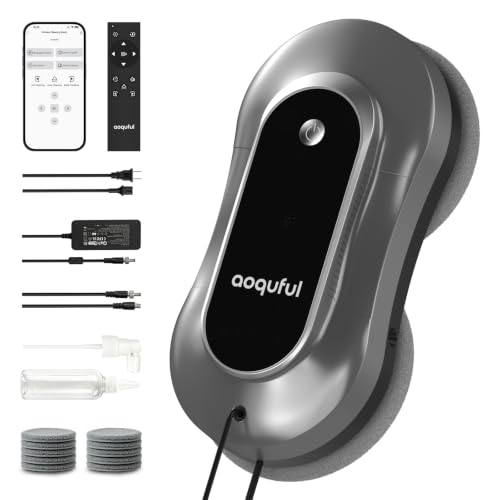
- Dual spray with 70 ml tank
- AI navigation, spot cleaning, and resume mode
- UPS battery, safety rope, and 12 washable cloths
Best For: High windows and multi-surface smooth glass cleaning
Adaptive Suction Pick
Tosima W5 Window Cleaning Robot
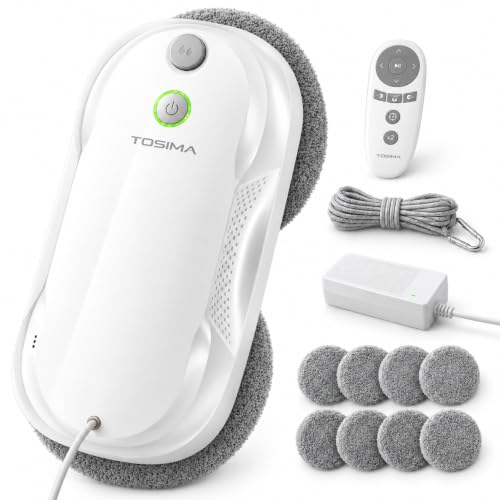
- Adaptive suction up to 6400 Pa
- Dual spray and dual-spiral cleaning design
- 25-minute backup battery with rope and edge detection
Best For: Compact homes and smooth glass windows needing secure cleaning
Best Value Water-Spraying Pick

- 5,600Pa suction with automatic or manual water spraying
- Three path-planning modes with frame and obstacle detection
- Includes remote, safety rope, water container, and replacement pads
Best For: Hands-off cleaning of smooth windows, tiles, and glass doors
Most Secure High-Window Pick

- 6,400Pa suction with backup battery protection
- 178-inch safety rope and air-pressure anti-drop sensor
- Dual spray, edge detection, and three cleaning modes
Best For: Indoor or outdoor high-rise glass cleaning
Smart Navigation Pick
BSD16 AI Window Cleaning Robot

- AI 5.0 path planning with edge and obstacle detection
- Dual water nozzles and double helix cleaning heads
- Remote offers three automatic modes plus manual control
Best For: Indoor glass, mirrors, and doors needing guided route planning
Best Value Dual-Spray Pick – 3000Pa Glass Cleaning Robot
For shoppers comparing window cleaning robots under 200, this model offers a practical feature set for routine glass maintenance. Its dual spray system, edge detection, intelligent path planning, and 3000Pa suction are designed for suitable vertical or angled glass surfaces.
Best For: Regular cleaning of smooth glass windows, glass doors, mirrors, and skylights angled at least 30 degrees from horizontal.
Pros:
- Dual atomizing spray with a 50ml tank and 10 microfiber cloths.
- Three cleaning paths, edge detection, and pressure sensing support automated coverage.
- Includes a safety rope and 20-minute UPS backup for power interruptions.
Cons:
- It must remain plugged in; the UPS is emergency backup rather than cordless operation.
- Heavy stains and debris should be pre-cleaned to protect suction.
- Not recommended for curved glass, thick trim, raised elements, or horizontal surfaces.
This is a sensible budget-oriented choice when your windows are smooth, suitable for robotic cleaning, and maintained with clean pads and controlled moisture. Expect the best results from a dry first pass followed by a damp second pass.
High-Suction High-Rise Pick – X6 6400Pa Window Robot
Among window cleaning robots under 200, the X6 stands out for its listed 6400Pa variable suction and round design. It is built for high or hard-to-reach smooth surfaces, with dual spray, edge detection, and a remote-controlled cleaning process.
Best For: High windows, floor-to-ceiling glass, skylights, mirrors, tile walls, and homes or offices needing broad surface compatibility.
Pros:
- 6400Pa variable suction is designed to adjust for different grime levels.
- Round body is claimed to cover 95% of the window area and reduce square-robot blind spots.
- 30-minute UPS backup, heavy-duty safety cable, and edge sensors provide multiple safety measures.
- Includes a 12-month warranty and remote operation.
Cons:
- At 63 dB, it may be noticeable while operating.
- Dirty pads or excessive water can cause smears, so pad care and moisture control are important.
- Stubborn buildup may require two cleaning passes.
The X6 is a strong candidate for buyers prioritizing suction and safety features. Its performance still depends on using the supplied cable, keeping pads clean, and applying only an appropriate amount of water.
Most Flexible Cleaning Modes – WA9C Pro Window Robot
For shoppers seeking window cleaning robots under 200 with more control over cleaning patterns, the WA9C Pro provides six intelligent modes and a remote. Its four-nozzle spray system is designed to distribute moisture evenly across glass while its sensors monitor adhesion and drops.
Best For: Glass windows, mirrors, and glass doors where users want selectable N-, Z-, or manual cleaning paths.
Pros:
- Four precision nozzles support even water coverage.
- Six cleaning modes include N-shape, Z-shape, and full manual control.
- 2600–3200Pa adsorption, pressure monitoring, and drop sensors support stable operation.
- 25-minute power-failure protection includes warning sounds and visual alerts.
Cons:
- It is described for glass windows and may be less versatile than models rated for tile walls.
- A safety rope must be anchored for overhead work.
- The listed 6-pound weight may be worth considering for storage and handling.
The WA9C Pro is appealing when cleaning flexibility matters more than maximum listed suction. Its manual mode is useful for targeted areas, while the included replacement nozzles, mops, and remote add practical convenience.
Large-Window Routine Pick – 6500Pa Dual-Spray Robot
This 6500Pa model is a practical option among window cleaning robots under 200 for homes with mixed-size panes. It combines dual-sided spray, a 60ml tank, smart edge detection, three route options, and remote operation for high or hard-to-reach glass.
Best For: Regular cleaning of small panes, large windows, glass doors, floor-to-ceiling glass, and other suitable smooth surfaces.
Pros:
- Up to 6500Pa suction and a 5-meter safety rope support secure attachment.
- Dual spray and a 60ml tank help distribute moisture across larger windows.
- Three cleaning paths—top-down, left-down, and right-down—offer route flexibility.
- Edge detection and obstacle awareness are designed for framed and frameless windows.
Cons:
- The product is intended for regularly maintained glass; heavy buildup may need pre-cleaning.
- Proper pad dampening, wringing, and washing are necessary to reduce smears.
- The listed 25-minute UPS backup should not be treated as cordless operating time.
This model makes sense for routine household cleaning where window sizes vary. Its larger tank and multiple route choices are useful, but results will depend on careful pad preparation and realistic expectations about stubborn stains.
Dual-Spray Smart Cleaner – AI Window Cleaning Robot
For shoppers comparing window cleaning robots under 200, this model stands out for its dual water spray, AI-assisted navigation, and broad compatibility with smooth glass surfaces, doors, tiles, and mirrors. Its spot-cleaning and resume functions add useful flexibility for larger or interrupted cleaning jobs.
Best For: High windows and households wanting app or remote control, reusable cloths, and extra outage protection.
Pros:
- Dual-spray system with a 70 ml water tank helps maintain useful cleaning dampness.
- AI navigation detects frames and obstacles, while spot and resume modes support more targeted cleaning.
- Triple safety setup includes edge detection, 2800 Pa suction, a 20–30 minute UPS battery, and a 4-meter safety rope.
- Includes 12 washable microfiber cloths plus remote and app control.
Cons:
- Its corded design means it must remain connected to power during operation.
- At 6.2 pounds, it is heavier than some compact alternatives.
- The 65 dB noise level may be noticeable in quiet rooms.
This is a feature-rich option for buyers who value coverage, reusable accessories, and safety features. The larger form factor and corded operation are worth considering before purchase.
Compact Edge Specialist – ECOVACS WINBOT MINI Window Robot
Among window cleaning robots under 200, the ECOVACS WINBOT MINI is designed for homes with narrow or hard-to-reach windows. Its slim 2.17-inch profile, ultrasonic spray, automatic path planning, and app-based cleaning modes make it a convenient everyday option for compatible flat, smooth glass.
Best For: Smaller windows, tight spaces, and users who want one-touch operation with optional app controls.
Pros:
- Compact 8.46-inch body and slim profile help it fit tighter spaces.
- Up to 7,500 Pa suction and nine-stage safety protection support cleaning at height.
- Ultrasonic spray and a 60 ml tank help loosen everyday dust, fingerprints, and water marks.
- Bumper-free design helps it clean closer to edges and corners.
Cons:
- It is intended for compatible flat, smooth glass and is not suitable for curved, cracked, or uneven surfaces.
- The included details specify a single washable cleaning pad, rather than a larger cloth assortment.
- Basic cleaning requires a power connection, and the pad should be properly wet and wrung out before use.
WINBOT MINI is a practical fit when compact sizing matters more than broad surface versatility. Its limitations around window condition and shape should be checked carefully before ordering.
Adaptive Suction Pick – Tosima W5 Window Cleaning Robot
For buyers researching window cleaning robots under 200, the Tosima W5 combines a compact design with adaptive suction, dual spray, and automatic navigation. It is built for smooth glass windows and can be operated with the included remote after a straightforward power-on setup.
Best For: Apartments, condos, and smaller homes needing a lightweight cleaner with strong grip and outage backup.
Pros:
- Variable-frequency adaptive suction reaches up to 6400 Pa and adjusts to the surface.
- Dual-spiral cleaning and dual spray help address dust, fingerprints, and stubborn stains.
- Triple safety system combines edge detection, a 220 kg-rated safety rope, and up to 25 minutes of backup battery power.
- Compact 4-pound body includes remote control and supports edge cleaning.
Cons:
- The product is specified for glass windows and smooth surfaces, so it may not suit textured or uneven materials.
- Remote control is listed, but app control is not specified.
- Its 6-inch cleaning path may require additional passes on larger windows.
The W5 offers a balanced combination of manageable size, adaptive grip, and safety features. It is especially appealing for smaller homes, though buyers wanting app control or a wider cleaning path may prefer another model.
Best Value Water-Spraying Pick – HCR-10 Window Cleaning Robot
If you are comparing window cleaning robots under 200, the HCR-10 stands out for combining automatic water spraying, 5,600Pa suction, and three path-planning modes. It is designed for smooth windows, tiles, and glass doors, with remote control for automatic or manual direction changes.
Best For: Shoppers who want hands-off cleaning with automatic spray control and broad smooth-surface compatibility.
Pros:
- Automatic or manual water-spraying modes help reduce hands-on work.
- 5,600Pa suction and a 300-pound-capacity safety rope support secure operation.
- Double spiral cleaning heads, microfiber pads, and frame detection target dirt without scratching.
- Includes 10 cleaning pads, four cleaning rings, a remote, and a water container.
Cons:
- The 30ml water container is relatively compact.
- Its corded-electric design requires access to a power source.
The HCR-10 is a practical option when automatic spraying and included accessories matter more than a larger tank. Its safety rope and obstacle detection are useful additions for exterior or hard-to-reach glass.
Most Secure High-Window Pick – Curalk 6400Pa Window Cleaner
Among window cleaning robots under 200, this updated Curalk model is geared toward users who prioritize suction strength and safety features. It combines variable-frequency suction up to 6,400Pa with backup power, air-pressure anti-drop protection, edge detection, and automatic dual-direction spraying.
Best For: Cleaning indoor or outdoor high-rise glass where backup power and a long safety rope are priorities.
Pros:
- Up to 6,400Pa variable-frequency suction adapts to different surfaces and dirt levels.
- Triple safety system includes a backup battery, air-pressure sensor, and 178-inch safety rope.
- Quick, deep, and spot cleaning modes provide different cleaning approaches.
- 90ml-class tank capacity and 10 replacement microfiber mop pads support longer sessions.
Cons:
- The manufacturer advises moistening pads to 50%–70% and pre-applying solution to the glass.
- Cleaning solution should not be poured directly into the machine because it may clog the nozzles.
This model is a strong fit for elevated or hard-to-reach windows because its safety package is more extensive than basic suction-only designs. The preparation instructions add a little setup, but they are important for maintaining spray performance.
Smart Navigation Pick – BSD16 AI Window Cleaning Robot
For shoppers evaluating window cleaning robots under 200, the BSD16 emphasizes intelligent route planning and flexible remote control. Its AI 5.0 path planning, edge detection, dual water nozzles, and double helix cleaning heads are designed to cover glass, mirrors, and doors with less manual direction.
Best For: Users who want multiple automatic modes, remote adjustments, and sensor-guided cleaning for glass surfaces.
Pros:
- AI 5.0 path planning detects frames and obstacles to guide cleaning routes.
- Dual water nozzles and double helix heads work with microfiber pads for dust, fingerprints, and smudges.
- Remote control offers three automatic modes plus manual operation and spray adjustment.
- UPS power storage can keep the robot operating for up to 30 minutes during an outage.
Cons:
- Its listed 3,000Pa suction is lower than the other supplied models.
- The product details specify indoor use, so exterior applications may be less suitable.
The BSD16 makes sense for routine indoor glass maintenance when navigation features and control flexibility are the main priorities. Its lower stated suction level may make it less compelling for buyers focused primarily on maximum holding power.
How We Picked the Best Window Cleaning Robots Under 200
We focused on the features that matter most in everyday window cleaning rather than relying on suction ratings alone. Our comparison considers suction strength, spray design, navigation, edge and corner handling, cleaning modes, safety backups, control options, and suitability for interior or exterior glass.
Because specifications and included accessories can vary by listing, check the current product page for exact cord lengths, safety tether details, pad types, supported surfaces, and replacement-part availability before buying.
Quick Comparison
- Best for compact spaces: Look for a smaller robot such as the ECOVACS WINBOT MINI, especially when window frames or storage space are limited.
- Best for stronger hold: Models advertising 5,600Pa to 6,500Pa suction may be appealing for larger or higher windows, provided the surface is smooth and compatible.
- Best for spray coverage: Dual-spray and four-nozzle designs can distribute cleaning solution more evenly, but they may require more frequent refilling.
- Best for control: App-enabled robots can offer easier start, stop, and mode selection, while remote-controlled models may be simpler for occasional use.
- Best for versatility: Some models are designed for windows, tiles, and glass doors, but always verify the manufacturer’s surface limitations.
Key Buying Factors for Window Cleaning Robots Under 200
Suction and Surface Compatibility
Higher advertised suction can improve stability, but it does not guarantee better cleaning on every window. These robots generally work best on smooth, flat glass. Textured, frosted, wet, heavily framed, or damaged surfaces may reduce grip or interfere with movement.
Navigation and Edge Detection
Intelligent path planning helps the robot cover more of the pane without excessive overlap. Edge detection is particularly important for frameless glass, while frame-aware navigation can help on standard windows. No robot should be left unattended during its first runs.
Spray System and Cleaning Pads
Dual-spray and ultrasonic systems can help manage dust and light grime, but robots are not a substitute for pre-cleaning heavy buildup. Confirm whether the unit uses a dedicated solution, plain water, or a manufacturer-approved cleaner, and check the cost of replacement pads.
Safety Features
A safety tether and backup power system are essential for elevated or exterior windows. Triple-safety systems may combine suction monitoring, battery backup, and a tether, but correct attachment and regular inspection still matter.
Who Should Buy Which Window Cleaning Robots Under 200?
Choose a compact model if you clean smaller panes, have limited storage, or want easier handling. Choose a higher-suction model for large smooth windows, while prioritizing a secure tether and backup battery for upper floors. Spray-focused models suit users who want less manual solution application, and app-controlled options are useful when you want to adjust cleaning modes from a distance.
For most buyers, the best value comes from balancing reliable safety equipment, useful navigation, washable pads, and suitable surface support instead of selecting the highest suction number. Measure your windows, inspect their texture and frames, and confirm the robot’s minimum and maximum supported dimensions before ordering.